
HotNets 2026 · Salt Lake City
Pramana
A Composable, Domain-Specific Backend for Empirical Networking Research
- Jaber Daneshamooz1
- Eugene Vuong1
- Alagappan Ramanathan2
- Manni Moghimi1
- Haarika Manda1
- Satyam Kumar3
- Snithik Thode3
- Satyandra Guthula1
- Sylee Beltiukov1
- Dongsu Han4
- Tarun Mangla3
- Sangeetha Abdu Jyothi2
- Walter Willinger5
- Arpit Gupta1
- 1UC Santa Barbara
- 2UC Irvine
- 3IIT Delhi
- 4KAIST
- 5Northwestern University
Try three intents from published papers
Pick an experiment from a published paper. Pramana checks the intent, writes the spec, composes the workflows, runs them, and plots what comes back.
- 1Intent
- 2Check
- 3Spec
- 4Workflows
- 5DAG
- 6Run
- 7Data
Abstract
Empirical networking research often tests a hypothesis with data the study itself generates, so accelerating this research requires shortening the time from forming a hypothesis to generating that data. Consider whether a bulk BBR download fairly shares its bottleneck with a Google Meet call. Testing this requires configuring a realistic bottleneck link, running the BBR transfer and the Meet call together, and collecting the call's quality metrics. Today a researcher builds this setup from scratch for each new idea; this delay from idea to data is the ideation-to-data gap. AI agents already propose hypotheses faster than researchers can generate data to test them. Closing the gap needs a backend that generates the data for each new hypothesis on demand, without a new setup.
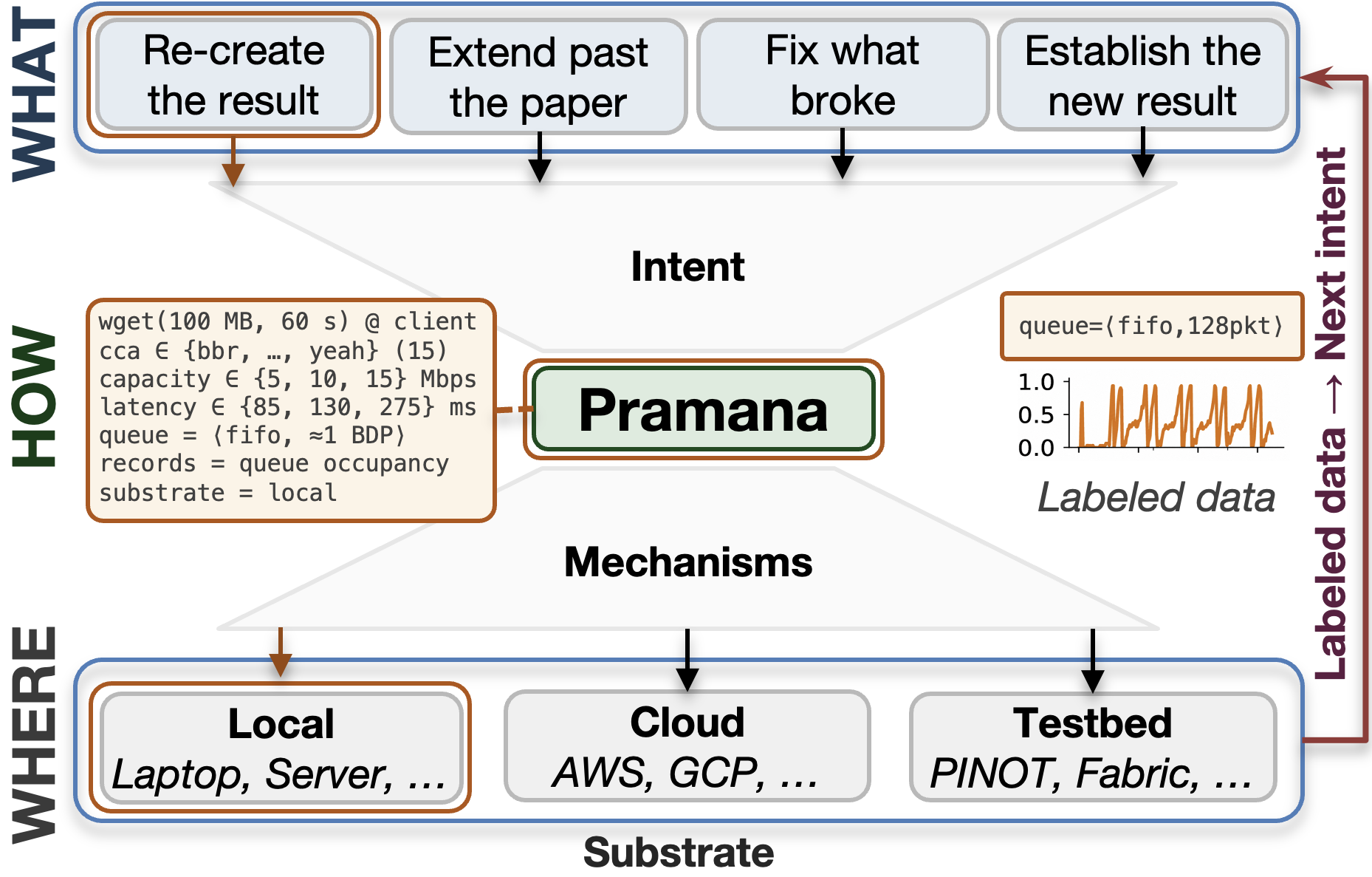
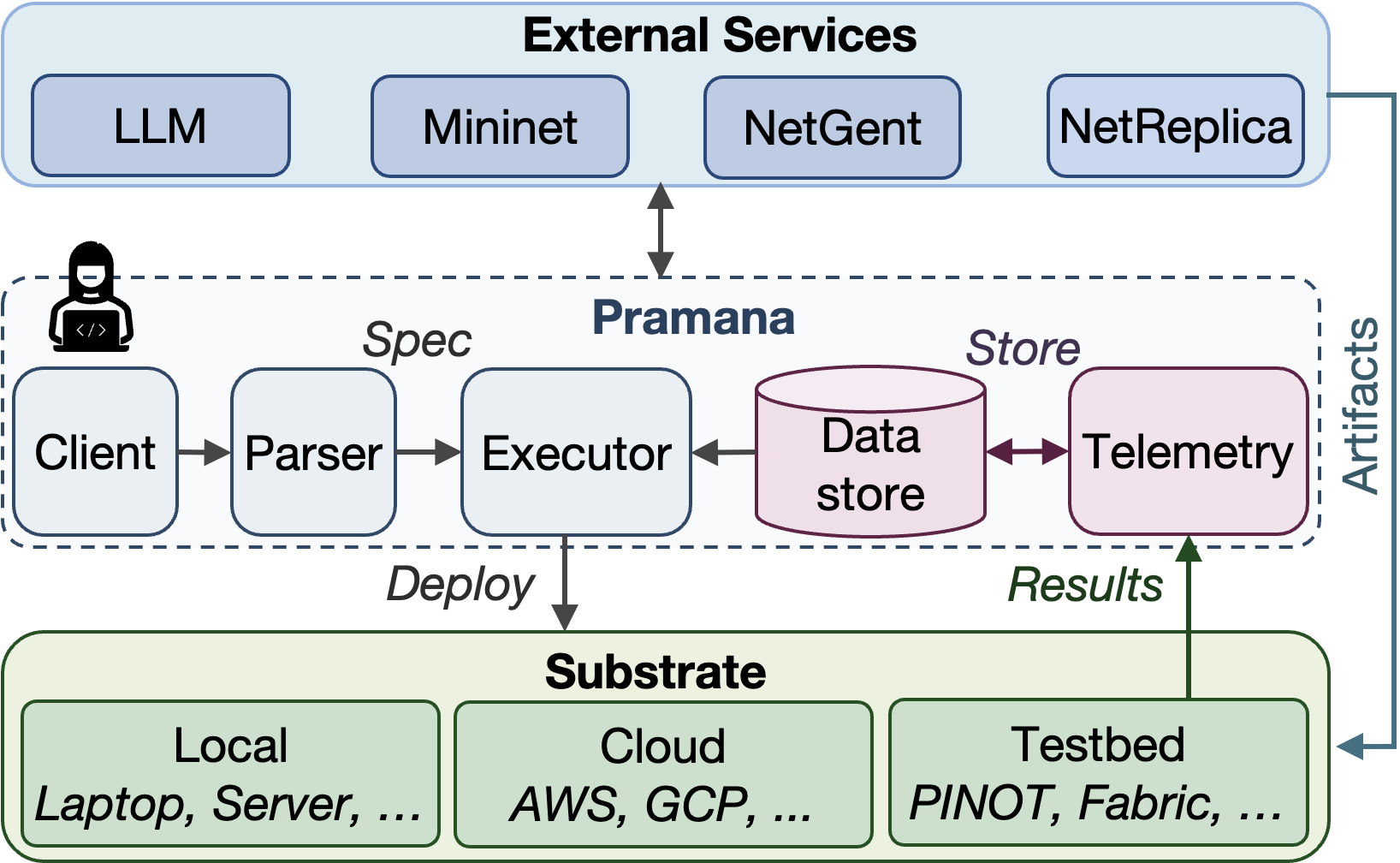
We envision Pramana, a composable backend for networking research designed as a thin waist, with research intents above it and execution substrates below. At its core, the intent specification separates the data a study needs (the intent) from where that data is generated (the substrate) and how it is produced (the mechanism), so one specification can target any substrate. We build a corpus of 255 data-generation intents from 66 published papers and find that the intent specification expresses all of them, while no existing tool covers more than 11%. Our proof-of-concept implementation covers 27% of these intents. For CCAnalyzer, one of the 66 papers, the implementation regenerated the data for one trial of each network setting and congestion-control algorithm in the paper's main experiment. We lay out what implementing the full design requires and why it needs a community effort.
Coverage of 255 intents from 66 papers
- data-generation intents in the corpus
- 255
- published papers they come from
- 66
- expressible in the intent specification
- 100%
- covered by the proof-of-concept implementation
- 27%
Video
HotNets '26 talk · 2:41
How it works
Intent
The data a study needs: the apps, the traffic, the metrics to record.
Substrate
Where the data is generated: a laptop, a cloud region, or a testbed like PINOT or FABRIC.
Mechanism
How it gets produced. The implementation composes two existing systems, NetReplica and NetGent.
BibTeX
@inproceedings{daneshamooz2026pramana,
  title     = {Pramana: A Composable, Domain-Specific Backend
               for Empirical Networking Research},
  author    = {Daneshamooz, Jaber and Vuong, Eugene and Ramanathan, Alagappan
               and Moghimi, Manni and Manda, Haarika and Kumar, Satyam
               and Thode, Snithik and Guthula, Satyandra and Beltiukov, Sylee
               and Han, Dongsu and Mangla, Tarun and Abdu Jyothi, Sangeetha
               and Willinger, Walter and Gupta, Arpit},
  booktitle = {Proceedings of the 25th ACM Workshop on Hot Topics in Networks},
  series    = {HotNets '26},
  address   = {Salt Lake City, UT, USA},
  year      = {2026}
}